

A residual current circuit breaker, or RCCB, is named after how many conductors it monitors at the same time. That number, two or four, is not an arbitrary spec. It is set by the supply that feeds the circuit: a single-phase supply needs a 2-pole RCCB, a three-phase supply with neutral needs a 4-pole RCCB. Pick the wrong one and the device either misses leakage on a conductor it never sees, or trips on a circuit it was never meant to protect.
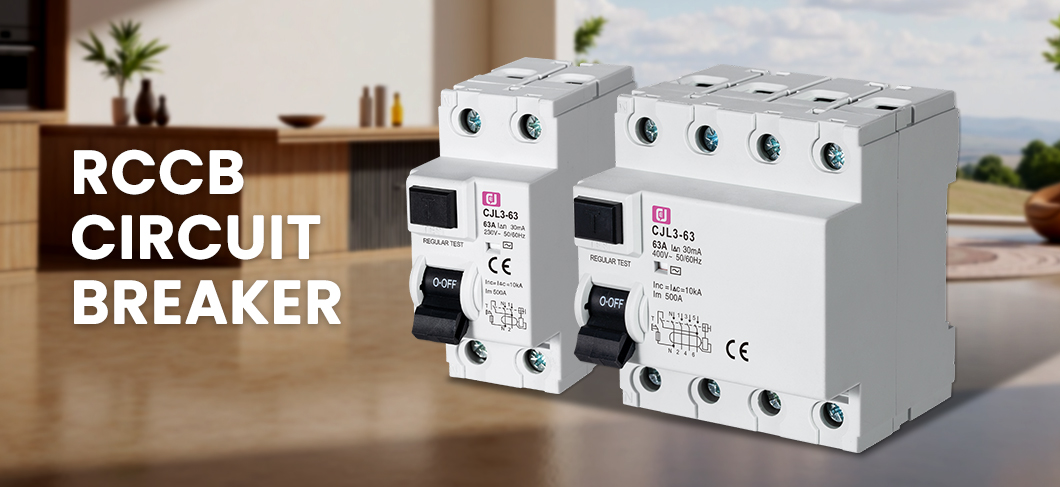
This guide explains what the pole count means in practice, when each configuration is required, where installers most often go wrong, and how the CJL3-63 II RCCB from C&J Electrical covers both cases in a single product family.
What the pole count actually means
The poles on an RCCB are the conductors the device monitors and disconnects. A 2-pole RCCB monitors the phase and the neutral of a single-phase circuit and trips by opening both. A 4-pole RCCB monitors the three phases and the neutral of a three-phase, four-wire circuit and trips by opening all four at once. The conductors on the load side of the device must be the only path for the protected current; any conductor bypassing the RCCB breaks the monitoring and the protection it provides.
In short: the pole count is fixed by the supply. A single-phase 230 V supply gets a 2-pole device. A three-phase 400 V supply with a neutral gets a 4-pole device. Anything else and either the device can’t do its job, or the installer has added cost and complexity for no reason.
Where a 2-pole RCCB fits
A 2-pole RCCB is the natural choice for residential apartments, small offices, shops and similar single-phase installations. It typically sits at the incomer of an SPN (single pole and neutral) distribution board, with outgoing single-pole MCB fed from a busbar and the protected neutrals kept separate on a dedicated neutral bar.
For socket circuits supplying ordinary household loads, a 30 mA residual operating current is the rating most often selected where additional protection against electric shock is required, subject to the installation design and applicable requirements. Higher ratings of 100 mA or 300 mA are typically chosen at the building incomer, where the priority is fire protection or coordination with downstream 30 mA devices.
Where a 4-pole RCCB fits
A 4-pole RCCB is required at the incomer of any three-phase, four-wire distribution system: commercial buildings with mixed single-phase and three-phase loads, light industrial workshops, three-phase motor feeders where complete isolation on a fault is required, and TPN (triple pole and neutral) distribution boards. All three phase conductors and the neutral must pass through the device.
A common question is whether three separate 2-pole RCCB can replace one 4-pole device on a three-phase system. For 3-phase connected equipment, the answer is generally no. A 4-pole RCCB measures the vector sum across all four conductors and trips on leakage regardless of which phase carries the fault. Two or three separate 2-pole devices monitor independent pairs and cannot detect leakage that circulates between phases through the connected equipment. Where the load is genuinely three-phase, a single 4-pole device is normally the correct specification.
Common wiring mistakes that cause nuisance tripping
Most nuisance trips on a correctly specified RCCB come down to a small number of recurring wiring errors. Each one breaks the rule that all current on the protected circuit must return through the device:
- Mixed neutrals. The neutral of a circuit protected by RCCB A is connected to the neutral bar of a circuit protected by RCCB B. Part of the return current leaks past RCCB A, which then sees an imbalance and trips.
- Skipped conductors. A phase or neutral conductor is connected to the load side without passing through the RCCB terminals. The device only sees part of the circuit, and any current on the skipped conductor never reaches the sensing toroid.
- Reversed line and load terminals. Manufacturers mark the line side and load side. Reversing them generally does not change tripping behaviour, but it does affect the test circuit and may give incorrect results during routine inspection.
- Damaged insulation or moisture in the installation. These are real residual currents, not wiring errors, but the fix is the same: find the cause rather than resetting the device repeatedly.
RCCB does not provide overcurrent protection
It is worth repeating because it comes up frequently. A standard RCCB detects residual current only. It does not protect against overload or short circuit. In a typical distribution board it is installed together with MCB that handle overcurrent, or upstream of a fuse or MCCB. An RCBO combines both functions in a single device and is a separate product category.
Introducing the CJL3-63 II
The CJL3-63 II is a residual current circuit breaker manufactured by Zhejiang C&J Electrical Co., Ltd. It is available in both 2-pole and 4-pole configurations, in Type A and Type AC residual current characteristics, and in electromagnetic and electronic versions. Rated currents cover 25 A, 40 A and 63 A, which suits residential sub-boards, small commercial panels and the incomer side of light commercial distribution boards. It is designed to IEC 61008-1 and EN 61008-1.
Key technical data of the CJL3-63 II:
| Mode | Electromagnetic type, electronic type |
| Residual current characteristics | Type A, Type AC |
| Number of poles | 2P, 4P |
| Rated current | 25 A, 40 A, 63 A |
| Rated voltage | AC 230 (240) / 400 (415) V |
| Rated frequency | 50/60 Hz |
| Rated residual operating current (IΔn) | 0.03, 0.1, 0.3, 0.5 A |
| Rated residual non-operating current (IΔno) | 0.5 IΔn |
| Rated making and breaking capacity (Im) | 500 A (In = 25 A, 40 A) · 10 In A (In = 63 A) |
| Rated conditional short-circuit current (Inc) | 10 kA |
| Rated conditional residual short-circuit current (IΔc) | 10 kA |
| Residual tripping current range | 0.5 IΔn to IΔn |
| Electro-mechanical endurance | 4,000 cycles |
| Connection capacity | Rigid conductor 25 mm² |
| Terminal tightening torque | 2.0 N·m |
| Mounting | 35.5 mm DIN rail / panel mounting |
| Protection class | IP20 |
| Standard | IEC 61008-1, EN 61008-1 |
Inc and IΔc are rated conditional values as defined in IEC 61008-1: the breaker is verified together with a specified short-circuit protective device (SCPD) in the test circuit. The 10 kA value describes the behaviour of the RCCB/SCPD combination, not the RCCB on its own.
CJL3-63 II features
The CJL3-63 II incorporates the following design features:
- 2-pole and 4-pole versions in the same product family, so a panel builder can stock one line for both single-phase and three-phase incomers.
- Type A and Type AC options. The Type A characteristic covers sinusoidal alternating and pulsating direct residual current, which matters in circuits supplying electronic equipment.
- Electromagnetic or electronic versions. The two differ in whether the residual-current tripping function relies on the line voltage; the choice between them depends on the supply conditions and the product specification.
- Multiple rated residual operating currents (30 mA, 100 mA, 300 mA, 500 mA), covering personal protection at the socket, fire protection at the incomer, and coordination levels in between.
- Im of 500 A at 25 A and 40 A ratings; 10 In A at 63 A, so the device scales with the rated current rather than being a single value across the range.
- Isolation function. The device can provide an isolation function where it is installed and wired for that purpose, in accordance with the applicable installation rules.
- Fire-resistant plastic parts, contact position indication and finger-protected terminals, supporting safer installation and inspection.
Application scenarios
The CJL3-63 II is suited to the following installations:
- Residential and small commercial distribution boards with single-phase supplies (2-pole version).
- TPN distribution boards and three-phase incomers in offices, shops and light commercial premises (4-pole version).
- Socket-outlet circuits supplying modern electronic equipment, where Type A residual current characteristics are relevant.
- Replacement of older RCCB where the existing enclosure space and DIN-rail mounting are retained.
About C&J Electrical
Zhejiang C&J Electrical Co., Ltd. is a manufacturer of low-voltage electrical products, focused on circuit breakers and related protection devices. C&J Electrical supports OEM brand customisation, offers a range of specifications, and can ship products as SKD kits for local assembly.
For more information on the CJL3-63 II or to request a quotation, please contact us.
Post time: Sep-03-2026