

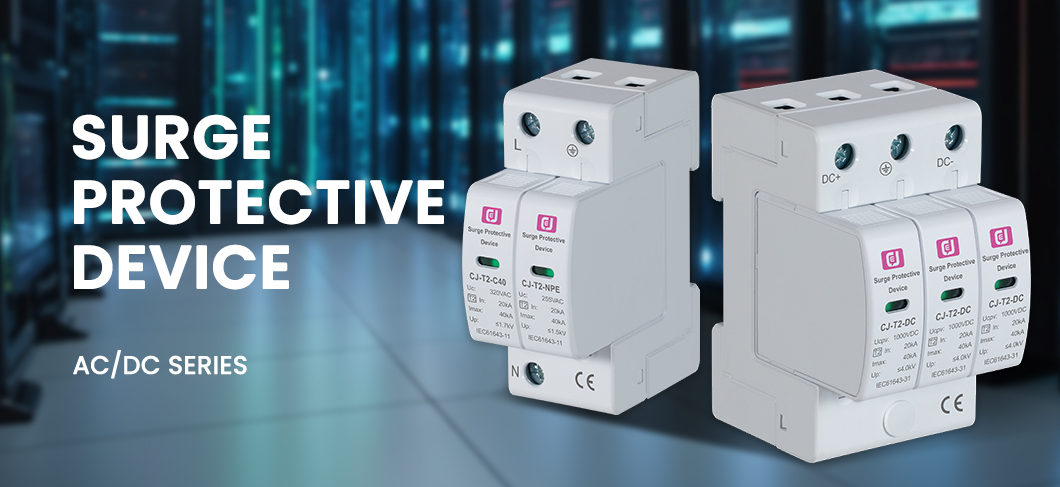
In the field of electrical systems and equipment protection, transient overvoltages (surges) are common potential hazards that can cause irreversible damage to electrical equipment, affect the normal operation of the system, and even lead to safety accidents. To solve this problem, the Surge Protection Device (SPD) has become an indispensable core component in electrical installation protection systems. However, many users, electrical practitioners and procurement personnel still have questions about this device: What is SPD? How does a Surge Protection Device work? What functions does it have and what application scenarios is it suitable for? This article will systematically answer these questions, integrate the required explanatory paragraphs, focus on introducing the Surge Protection Device (SPD) from overview, working principle, core functions to application scenarios, and highlight the Surge Protection Device (SPD) launched byZhejiang C&J Electrical co., ltd. (C&J Electrical)—a high-quality, safe and reliable Surge Protection Device (SPD) with complete specifications and wide applicability, which provides professional surge protection solutions for various DC power supply systems.
First, we clearly define what a Surge Protection Device (SPD) is: A surge protection device (also called SPD) is a component of the electrical installation protection system. This device is connected in parallel on the power supply circuit of the loads that it must protect, but it can also be used at all levels of the power supply network. In short, the Surge Protection Device (SPD) is a special electrical device designed to limit transient overvoltages and divert surge currents, which can protect electrical equipment and systems from damage caused by surges[1][5]. It is also known as a transient voltage surge suppressor (TVSS) in some historical contexts, but the term Surge Protection Device (SPD) has become the standard name in the industry since the adoption of relevant international standards[4].
The Surge Protection Device (SPD) is mainly used to deal with transient overvoltages, which are sudden, short-duration voltage spikes in the power supply circuit, usually caused by lightning strikes, power grid switching operations, equipment start-stop interference, and other factors[1][5]. These voltage spikes are much higher than the rated voltage of the equipment, and if not effectively suppressed, they will easily burn out the internal components of the equipment, damage the circuit board, and even cause fires and other safety hazards[1][5]. The Surge Protection Device (SPD) is like a “safety valve” in the electrical system. It stays in a standby state under normal working conditions and quickly acts when a surge occurs, diverting the surge current and limiting the voltage to a safe range, thus protecting the equipment[5].
How Does a Surge Protection Device (SPD) Work?
The working principle of the Surge Protection Device (SPD) is based on the nonlinear characteristics of its internal components, which can realize the switching between high impedance and low impedance according to the change of the circuit voltage, so as to achieve the purpose of surge protection[1][5]. Its core working process can be divided into three stages, which are simple and easy to understand:
- Standby State (Normal Working Voltage): Under normal working conditions, the voltage of the power supply circuit is stable and within the rated range. At this time, the Surge Protection Device (SPD) is in a high-impedance state, which is equivalent to an open circuit in the circuit[5]. It does not affect the normal operation of the power supply circuit and the load equipment, and only stays in a standby state to monitor the voltage change of the circuit in real time[5].
- Surge Response State (Transient Overvoltage Occurs): When a transient overvoltage (surge) occurs in the circuit and the voltage exceeds the protection threshold of the Surge Protection Device (SPD), the internal nonlinear components (such as zinc oxide varistors, transient suppression diodes) of the SPD will quickly conduct, and the impedance will drop sharply to a low-impedance state[1][5]. At this time, the SPD will form a low-resistance channel, divert most of the surge current to the ground, and at the same time clamp the transient overvoltage to a safe level that the equipment can bear, preventing the surge from invading the load equipment[1][5].
- Reset State (Surge Disappears): After the surge is released and the circuit voltage returns to the normal rated range, the internal components of the Surge Protection Device (SPD) will automatically reset, restore to the high-impedance standby state, and continue to monitor the circuit voltage, waiting for the next surge response[5]. This automatic reset function ensures that the SPD can work continuously and provide long-term surge protection for the system[5].
It should be emphasized that the Surge Protection Device (SPD) is usually connected in parallel to the power supply circuit of the protected load, which can quickly divert the surge current without affecting the normal power supply of the load[3][4]. At the same time, it can be installed at all levels of the power supply network, forming a multi-level surge protection system, which can more comprehensively suppress surges and ensure the safe operation of the entire electrical system[2][3].
Core Functions of Surge Protection Device (SPD)
As a key component of the electrical installation protection system, the Surge Protection Device (SPD) integrates multiple practical functions, not only realizing the basic surge suppression, but also providing comprehensive protection for the electrical system and equipment. Its core functions are as follows:
- Surge Current Diverting Function: This is the most basic and core function of the Surge Protection Device (SPD)[5]. When a surge occurs, the SPD can quickly divert the huge surge current to the ground through its internal low-resistance channel, reducing the impact of the surge current on the load equipment and the power supply circuit, and avoiding equipment damage caused by excessive current[1][5].
- Transient Overvoltage Limiting Function: While diverting the surge current, the Surge Protection Device (SPD) can clamp the transient overvoltage to a safe level (voltage protection level Up) that the load equipment can bear[3][4]. It prevents the overvoltage from invading the internal components of the equipment, ensuring that the equipment works within the rated voltage range and avoiding component burnout[1][3].
- Fault Alarm Function: High-quality Surge Protection Device (SPD) is equipped with a fault alarm mechanism[6]. When the SPD fails (such as component aging, damage) and cannot work normally, the alarm device will send a signal (such as the color change of the indicator window, remote alarm signal), reminding the operator to replace the SPD in time to avoid the loss of surge protection function[6].
- Thermal Disconnection Protection Function: The Surge Protection Device (SPD) is equipped with a thermal disconnection device, which can automatically disconnect the SPD from the circuit when the internal components are overheated due to long-term operation or surge impact[6]. This prevents the SPD from catching fire or being damaged due to overheating, and ensures the safety of the entire electrical system[6].
- Stable Operation Function: The Surge Protection Device (SPD) is designed with high-quality components and strict production processes, which has good environmental adaptability and long service life[6]. It can maintain stable performance under different temperature, humidity and other environmental conditions, and can work reliably for a long time, reducing the frequency of maintenance and replacement[6].
- Easy Installation and Maintenance Function: The pluggable Surge Protection Device (SPD) is easy to install and maintain[6]. The module can be quickly plugged and unplugged, which is convenient for operators to install, replace and maintain, saving time and labor costs[6].
Types and Classification of Surge Protection Device (SPD)
According to different classification standards, Surge Protection Device (SPD) can be divided into different types, which can be flexibly selected according to the actual application scenarios and protection requirements. The common classification methods are as follows:
- According to the protection level: It can be divided into Class I, Class II and Class III Surge Protection Device (SPD)[4]. Class I SPD is mainly used for the first-level protection of the power supply entrance, which can bear large surge current and is suitable for LPZ0A-1 boundary; Class II (Class C) SPD is used for the second-level protection, which is suitable for LPZ0B-1 or higher, and is mainly used to suppress the residual surge after the first-level protection[2][4]; Class III SPD is used for the third-level protection, which is installed near the protected equipment to provide precise protection for sensitive equipment[4].
- According to the power supply type: It can be divided into AC Surge Protection Device (SPD) and DCSurge Protection Device (SPD)[1][3]. AC SPD is used for AC power supply systems (such as 220V, 380V power grids), while DC SPD is used for DC power supply systems (such as 1000VDC, 1200VDC, 1500VDC), which is suitable for new energy, communication and other fields[3][6].
- According to the installation form: It can be divided into pluggableSurge Protection Device (SPD) and fixed Surge Protection Device (SPD)[6]. Pluggable SPD has the advantages of easy installation and maintenance, and the module can be replaced without power failure; fixed SPD is integrated, which is suitable for scenarios with stable installation environment and low maintenance frequency[6].
Application Scenarios of Surge Protection Device (SPD)
With the rapid development of electrical and electronic technology, the types of electrical equipment are becoming more and more diverse, and the requirements for surge protection are also getting higher and higher. The Surge Protection Device (SPD), as an important protection component, is widely used in various fields that require surge protection, especially in DC power supply systems. The specific application scenarios are as follows:
- New Energy Field: It is widely used in DC power supply systems such as photovoltaic power generation and wind power generation[1]. In photovoltaic power plants, the Surge Protection Device (SPD) is installed in photovoltaic inverters, combiner boxes and other equipment to protect the DC power supply circuit from surge damage caused by lightning strikes and other factors, ensuring the stable operation of the new energy power generation system[1][6].
- Communication Field: In communication base stations, data centers and other places, the DC power supply system is the core of equipment operation[1][4]. The Surge Protection Device (SPD) can protect the communication equipment, servers, switches and other devices from surge damage, avoid communication interruption and data loss, and ensure the normal operation of the communication system[1][4].
- Industrial Automation Field: In industrial production workshops, the DC power supply system is widely used in motors, sensors, programmable logic controllers (PLC) and other equipment[4][6]. The Surge Protection Device (SPD) can suppress the surges generated by equipment start-stop and power grid switching, protect the industrial control equipment from damage, and ensure the continuity of production[4][6].
- Medical Field: Medical equipment (such as medical monitors, diagnostic equipment) has high precision and high requirements for power supply stability[4]. The Surge Protection Device (SPD) can provide reliable surge protection for the DC power supply system of medical equipment, avoid equipment failure caused by surges, and ensure the normal operation of medical work[4].
- Municipal and Transportation Field: In municipal facilities such as street lighting, traffic signals, and subway systems, DC power supply systems are often used[4][6]. The Surge Protection Device (SPD) can protect the related electrical equipment from surge damage, ensure the normal operation of municipal facilities and transportation systems, and maintain urban operation order[4][6].
- OEM Supporting Scenarios: It is suitable for OEM supporting, and can be integrated into various DC power supply equipment and systems to provide professional surge protection functions for the equipment[6]. Multiple specifications can be flexibly matched with different OEM products, improving the added value and competitiveness of the whole equipment[6].
Overview of C&J Electrical Surge Protection Device (SPD)
To meet the diverse needs of the market for DC power supply system surge protection, C&J Electrical has independently developed and produced a high-performance pluggable Surge Protection Device (SPD), which is a Class II (Class C) SPD designed according to IEC 61643-1/GB 18802.1 international and national standards[3][6]. This Surge Protection Device (SPD) is suitable for installation at LPZ0B-1 or higher, and is mainly used to protect DC power supply systems from surge damage, which can be widely applied to various DC power supply systems[2][6].
The product has multiple specifications optional, supports OEM brand customization services, and has high safety performance. It adopts high-quality components and strict production processes, with pluggable module design, high discharge capacity, quick response and complete protection functions. It can meet the personalized needs of different users and partners, and provide reliable surge protection for various DC power supply scenarios[6].
Technical Data and Structure Characteristics of C&J Electrical Surge Protection Device (SPD)
General
For installation at LPZ0B-1 or higher, protecting d.c power supply system from surge damages. Applied in pluggable SPD Class II (Class C) for various d.c. power supply system. Designed according to IEC 61643-1/GB 18802.1.
Structure characteristics
- Pluggable module, easy for installation and maintenance
- High discharge capacity, quick response
- Double thermal disconnection devices, provide more reliable protection
- Multifunctional terminals for connection of conductors and busbars
- Green window will change when fault occurs, also provide remote alarm terminal
Technical Data
|
Technical Parameters
|
Specifications
|
|---|---|
|
Type
|
CJ-T2-DC/2P, CJ-T2-DC/3P
|
|
Rated voltage(max.continuous ac.voltage)[ Uc ]
|
1000VDC / 1200VDC / 1500VDC(3P)
|
|
Nominal discharge current(8/20)[ ln ]
|
20kA
|
|
Maximum discharge current[ lmax ]
|
40kA
|
|
Voltage protection level [ Up ]
|
2.8kV / 4.0kV
|
|
Response time[tA]
|
≤25ns
|
|
Max.backup fuse
|
125AgL/gG
|
|
Operating temperature range[ Tu ]
|
-40°C-+80°C
|
|
Cross-sectional area
|
1.5mm²~25mm² solid/35mm² flexible
|
|
Mounting on
|
35mm DIN rail
|
|
Enclosure material
|
Purple (module)/light gray (base)thermoplastic, UL94-V0
|
|
Dimension
|
1 mod
|
|
Test standards
|
IEC 61643-1;GB 18802.1;YD/T 1235.1
|
|
Type of remote signalling contact
|
Switching contact
|
|
Switching capacity a.c.
|
250V/0.5A
|
|
Switching capacity d.c
|
250V/0.1A;125V/0.2A;75V/0.5A
|
|
Cross-sectional area for remote signalling contact
|
Max.1.5mm² solid/flexible
|
Product Advantages of C&J Electrical Surge Protection Device (SPD)
In the competitive Surge Protection Device (SPD) market, the Surge Protection Device (SPD) of C&J Electrical has obvious advantages, relying on its stable performance, complete functions and high cost performance, and has won the trust of users. Compared with ordinary Surge Protection Device (SPD) products on the market, its specific advantages are as follows:
- Compliant with International and National Standards: The product is designed according to IEC 61643-1/GB 18802.1 international and national standards, and has passed relevant tests[3][6]. It meets the test requirements of YD/T 1235.1, ensuring that its performance and safety meet the industry standards, and can be widely used in domestic and foreign markets[6].
- Multiple Specifications Optional: The product has two types: CJ-T2-DC/2P and CJ-T2-DC/3P, and the rated voltage covers 1000VDC, 1200VDC and 1500VDC (3P)[6]. It can flexibly adapt to different DC power supply system requirements and application scenarios, with strong versatility[6].
- Easy Installation and Maintenance: Adopting pluggable module design, the module can be quickly plugged and unplugged, which is convenient for operators to install, replace and maintain[6]. It does not need to cut off the entire power supply during maintenance, saving time and labor costs[6].
- High Discharge Capacity and Quick Response: The nominal discharge current is 20kA, and the maximum discharge current is 40kA[6], which can effectively divert large surge currents; the response time is ≤25ns[6], which can quickly respond to transient overvoltages, timely suppress surges, and avoid equipment damage[5].
- High Safety Performance: Equipped with double thermal disconnection devices, which can provide more reliable protection[6]. When the internal components are overheated, it can automatically disconnect the circuit to prevent fire and other safety hazards; the enclosure is made of thermoplastic material (UL94-V0), which has good flame retardant performance[6]. The protection level is excellent, which can effectively protect the internal components from damage[6].
- Intelligent Fault Alarm: The green window will change color when a fault occurs, which is convenient for operators to check the working status of the SPD in time[6]; it is also equipped with a remote alarm terminal, which can send remote alarm signals, realizing real-time monitoring and timely handling of faults[6].
- Convenient Connection: Equipped with multifunctional terminals, which can be used for connecting conductors and busbars[6], with strong adaptability, and can meet different connection needs[6].
- Wide Environmental Adaptability: The operating temperature range is -40°C to +80°C[6], which can adapt to harsh working environments such as low temperature and high temperature, and maintain stable performance in various complex environments[6].
- OEM Customization Support: We support OEM brand customization services, which can be customized according to the specific needs of users, including brand LOGO, product specifications and functions, to meet the personalized needs of different users and OEM partners[6].
- Wide Application Scenarios: The product is suitable for various DC power supply systems, and can be widely applied to new energy, communication, industrial automation, medical, municipal and other fields[6], providing professional surge protection solutions for various equipment[1][4].
Why Choose C&J Electrical Surge Protection Device (SPD)?
As a professional electrical equipment manufacturer, C&J Electrical has rich experience in R&D and production of Surge Protection Device (SPD). The Surge Protection Device (SPD) produced by our company is manufactured through strict quality control and testing procedures, ensuring that each product meets relevant standards and has stable and reliable performance[6]. We always adhere to the user-oriented concept, continuously optimize product performance and improve product quality, to provide users with cost-effective and practical surge protection solutions[4].
Compared with other Surge Protection Device (SPD) products on the market, our products have obvious advantages in standardization, performance and safety: compliance with international and national standards ensures wide applicability; multiple specifications and flexible connection methods can meet diverse needs; high discharge capacity, quick response and double thermal disconnection devices ensure high safety performance and stable operation[6]. In addition, the product supports OEM customization and has multiple specifications optional, which can better meet the personalized needs of users and partners[6].
We provide perfect after-sales service and technical support. If you have any questions about the selection, installation, use or customization of our Surge Protection Device (SPD), please feel free to contact C&J Electrical. Our professional technical team will provide you with tailored solutions and reliable technical support to ensure that the product can play its best performance and meet your surge protection needs.
Post time: Apr-30-2026