

Working Principle, Types & Applications — Featuring the CJL1-125 RCCB by C&J Electrical
Electricity powers almost everything we do, yet it also carries a hidden risk. Worn insulation, faulty wiring and damp environments can all cause electric current to “leak” away from its intended path — and that leakage can be dangerous. This is where the residual current circuit breaker, or RCCB, comes in. As an important safety device in any modern electrical installation, the RCCB helps reduce the risk of electric shock by detecting residual current and disconnecting the circuit when the residual current reaches the specified operating level.
In this guide we explain what an RCCB is, how it works, how it differs from an MCB, MCCB and RCBO, and we introduce the CJL1-125 RCCB from C&J Electrical — a reliable, IEC-compliant solution for residential, commercial and industrial applications.
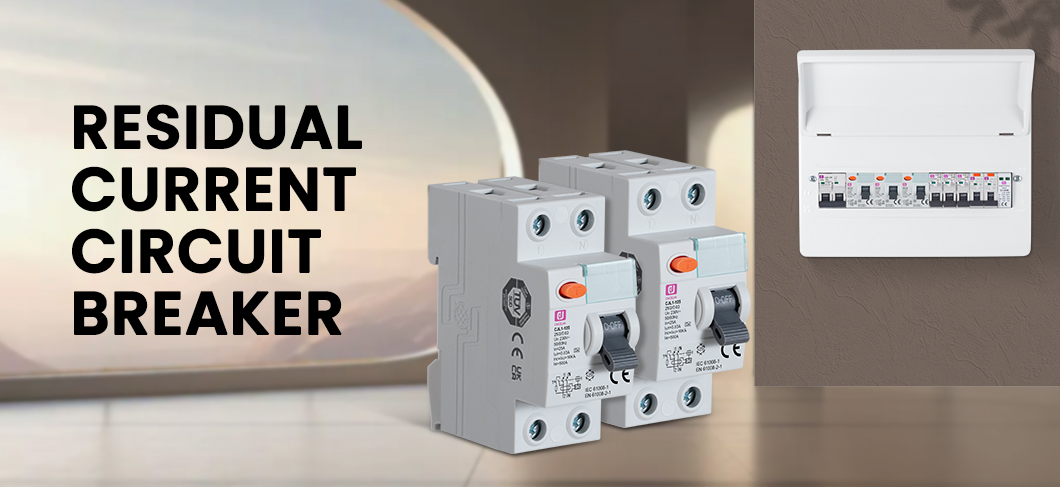
What Is an RCCB?
An RCCB (Residual Current Circuit Breaker) is a device that continuously monitors the balance of electric current in a circuit and disconnects the power when it detects a leakage to earth. An RCCB is a type of residual current device (RCD). The term ELCB may still appear in older documentation, although modern RCCB operate by detecting residual current.
The core function of an RCCB is to detect residual current and disconnect the circuit when the specified operating condition is reached, helping reduce the risk of electric shock. Unlike a conventional circuit breaker, which responds to overloads and short circuits, an RCCB is tuned to detect the small leakage currents that can flow outside the intended current path. For example, a 30 mA RCCB is designed to operate when the residual current reaches its specified operating level.
How Does an RCCB Work?
The working principle of an RCCB rests on a fundamental rule of physics: in a healthy circuit, the current flowing out through the live (phase) conductor must exactly equal the current returning through the neutral conductor.
Inside the RCCB is a toroidal current transformer — a ring-shaped magnetic core through which both the live and neutral wires pass. Under normal conditions the magnetic fields generated by these two currents are equal and opposite, so they cancel each other out. The core stays balanced and electricity flows freely.
When a fault occurs — a person touches a live part, or moisture creates a path to earth — part of the current escapes to the ground instead of returning through the neutral wire. This difference is called the residual current. When the residual current reaches the device’s specified operating level, the sensing coil detects the imbalance and triggers the trip mechanism, opening the contacts and cutting the power.
By disconnecting the circuit when the residual current reaches the operating level, an RCCB helps reduce the risk of electric shock and electrical fire. Residual current protection is therefore an important part of modern electrical installations.
RCCB vs MCB vs MCCB vs RCBO: What’s the Difference?
This is the question installers hear most often, and the answer comes down to what each device protects:
- MCB (Miniature Circuit Breaker) — protects wiring and equipment from overload and short circuit, but cannot detect earth leakage.
- MCCB (Molded Case Circuit Breaker) — generally used for higher-current distribution and protection applications and available in a wide range of current ratings and trip configurations; like the MCB, it does not detect earth leakage.
- RCCB (Residual Current Circuit Breaker) — detects earth leakage current and helps reduce the risk of electric shock, but does not protect against overload or short circuit.
- RCBO (Residual Current Breaker with Overcurrent protection) — combines both functions in one device, protecting against leakage, overload and short circuit.
In many installations, an RCCB is used together with overcurrent protective devices such as an MCB or MCCB: the RCCB provides residual current protection, while the MCB or MCCB protects against overload and short circuit, depending on the system design and local electrical requirements.
Understanding RCCB Types: AC, A and B
Not all leakage currents have the same waveform, so RCCB are classified into types:
- Type AC — designed to detect sinusoidal AC residual currents and suitable for applications where the residual current is expected to be purely AC.
- Type A — capable of detecting sinusoidal AC and pulsating DC residual currents, making it suitable for many circuits supplying modern electronic equipment.
- Type B — capable of detecting AC, pulsating DC and smooth DC residual currents and may be required for certain applications, such as some EV charging systems, photovoltaic systems and variable-speed drives, depending on the equipment design and applicable installation requirements.
The CJL1-125 is available in AC, A and B types, so it can be matched precisely to the needs of each installation.
Introducing the CJL1-125 RCCB
The CJL1-125 is a residual current circuit breaker designed and manufactured by Zhejiang C&J Electrical Co., Ltd. It delivers dependable residual current protection across a wide range of ratings, making it a flexible choice for distributors, contractors and panel builders.
Key technical data of the CJL1-125:
| Rated current | 16A, 20A, 25A, 32A, 40A, 50A, 63A, 100A, 125A |
| Rated voltage | 230V (1P+N), 400V (3P+N) |
| Rated frequency | 50/60 Hz |
| Number of poles | 2P, 4P |
| Module width | 36 mm |
| Circuit types | AC type, A type, B type |
| Breaking capacity | 6,000 A |
| Rated residual operating current | 10, 30, 100, 300 mA |
| Operating temperature | 5°C to 40°C |
| Terminal tightening torque | 2.5–4 N·m |
| Terminal capacity (top / bottom) | 25 mm² |
| Electro-mechanical endurance | 4,000 cycles |
| Mounting | 35 mm DIN rail |
| Compliance | IEC 61008-1, IEC 61008-2-1 |
Product Advantages
The CJL1-125 is built with careful attention to detail:
- Copper current-carrying components — the current-carrying components are made of copper, providing good electrical conductivity and a long service life.
- Sealed screw protection — every screw is covered by a plastic cap that seals the hole, adding an extra layer of safety and preventing accidental contact.
- New-generation tripping structure — a carefully engineered release mechanism delivers stable, reliable tripping performance.
- Large transparent label window — a generously sized clear signboard gives installers room to add their own markings.
- Engineered polymer operating mechanism — the operating mechanism uses an engineered polymer structure designed for reliable mechanical operation and insulation performance.
Application Scenarios
Thanks to its wide current range and multiple types, the CJL1-125 fits many environments:
- Residential buildings — protecting socket outlets, kitchens, bathrooms and outdoor circuits.
- Commercial spaces — offices, shops and public buildings.
- Industrial facilities — workshops and equipment lines with higher rated currents.
- Wet and high-risk zones — wherever moisture raises the risk of electric shock.
About C&J Electrical
Zhejiang C&J Electrical Co., Ltd. is a manufacturer of low-voltage electrical products, focused on circuit breakers and related protection devices. With years of experience in research, development and production, C&J Electrical supports OEM brand customization, offers a wide range of specifications, and can ship products as SKD kits for convenient local assembly. We are committed to safe and reliable products.
If you have any questions about the CJL1-125 RCCB or would like a quotation, please get in touch — our team is ready to help.
Post time: Aug-21-2026