

How to match the trip settings to a motor’s starting current, featuring the CJMM9 series MCCB from C&J Electrical
A moulded case circuit breaker, or MCCB, protecting a motor circuit is selected differently from one protecting a lighting or heating feeder. A motor draws a starting current several times its full-load current for a short time, and it can be overloaded without any fault being present. If the breaker trips too early, the motor cannot start; if it is set too loosely, the motor and the cable are left without real protection. This article looks at what to check, the trip characteristics the catalogue gives for motor protection, and how the CJMM9 series MCCB is applied to motor circuits.
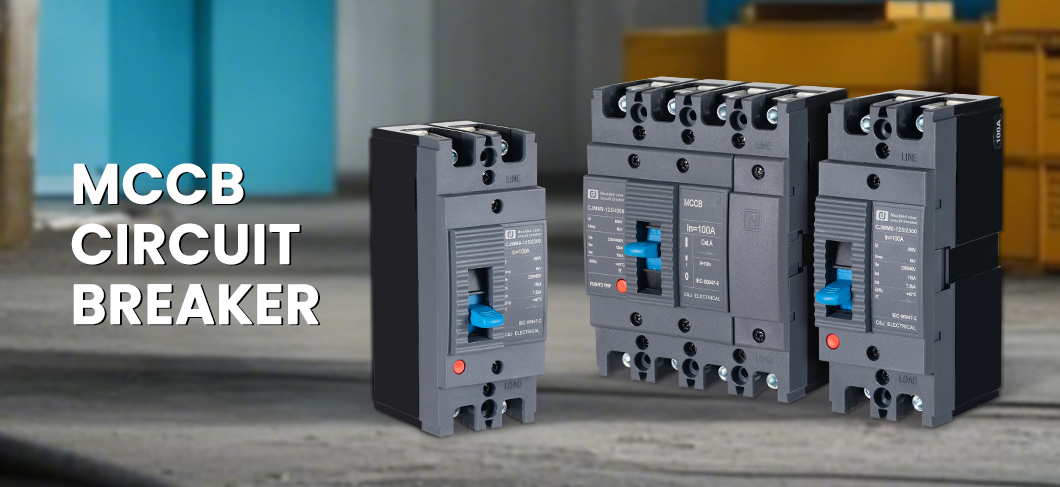
Why motor circuits are selected differently
A motor is not a steady resistive load. During starting, the current can reach several times the full-load value until the motor reaches its operating speed, and an overloaded motor can draw current above its rating for some time before the winding is at risk. The MCCB therefore has to allow a temporary overcurrent that would not be acceptable on an ordinary distribution feeder, while still tripping on a genuine overload and on a short circuit. For this reason the circuit breaker is chosen for motor protection rather than for distribution protection, and the two duties are listed separately in the product data.
Motor protection trip characteristics
The CJMM9 catalogue lists separate overcurrent trip characteristics for distribution breakers and for motor protection breakers, tested with all poles energised simultaneously and without temperature compensation. The motor protection overload values sit closer to the rated current, because the job here is to protect the motor itself.
For motor protection circuit breakers, at an ambient temperature of +40 °C, the inverse time-delay characteristics are as follows:
- Overload long delay, agreed non-trip current: 1.0 In, at least 2 h, cold state.
- Overload long delay, agreed trip current: 1.2 In, within 2 h, hot state.
- Short-circuit transient, agreed non-trip current: 9.6 In, at least 0.2 s, cold state.
- Short-circuit transient, agreed trip current: 14.4 In, within 0.2 s.
By comparison, the distribution protection characteristics use 1.05 In and 1.3 In for the overload stage and 8 In and 12 In for the short-circuit stage. The motor protection figures show how the breaker carries the starting current without tripping and then clears a real fault quickly.
Check the rated current against the motor full-load current
The rated current In of the breaker must suit the motor and the circuit. The selection should be based on the full-load current of the motor and the requirements of the applicable installation rules, not on the motor rating in kilowatts alone. The CJMM9 series offers rated currents from 32 A to 1600 A across its seven frame sizes, so the available steps are shown in the technical data below.
Check the breaking capacity against the fault level
The motor circuit is usually connected to a distribution board where the prospective short-circuit current can be high, so the breaking capacity of the MCCB must be checked against the fault level at the point of installation. The CJMM9 series is available in M-type and H-type breaking capacity classes, and the rated Ics/Icu values for each model are listed in the catalogue.
Which trip unit type to use
The CJMM9 series offers thermal trip, magnetic trip and thermal-magnetic trip units. On a motor circuit the thermal element covers overload and the magnetic element covers short circuit, which is the combination the motor protection characteristics describe.
Accessories that matter on a motor circuit
The CJMM9 series can be fitted with internal accessories used in motor control and protection:
- Undervoltage trip unit. It operates when the supply voltage drops to between 70% and 35% of the rated voltage, and it prevents closing below 35%, so the motor does not restart by itself when the supply returns.
- Shunt trip unit. It operates reliably at rated voltage values between 70% and 110%, so the breaker can be opened remotely for an emergency stop.
- Auxiliary and alarm contacts. They signal the open and closed positions and a fault trip, for indication and control wiring.
Introducing the CJMM9 series MCCB
The CJMM9 series circuit breakers are developed by C&J Electrical to meet the demands of domestic and international markets. With a maximum rated insulation voltage of 1000 V (690 V for the 125 A frame size), these breakers are suitable for AC 50 Hz, a rated operating voltage of 400 V, and a rated operating current up to 1600 A. They are used to distribute electrical power and protect circuits and power equipment from damage caused by overloads, short circuits, undervoltage and other faults, and can also serve as infrequent starters for motors, providing overload, short-circuit and undervoltage protection. The series can be installed vertically (upright mounting) or horizontally (sideways mounting), complies with IEC 60947-2 and GB/T 14048.2, and is classified by rated ultimate short-circuit breaking capacity into M-type and H-type.
Key technical data of the CJMM9 series:
| Standard | IEC 60947-2, GB/T 14048.2 |
| Frame rating current Imn | 125 A, 160 A, 250 A, 400 A, 630 A, 800 A, 1600 A |
| Rated current In | 125 A frame: 32/40/50/63/80/100/125 A; 160 A frame: 125/140/160 A; 250 A frame: 160/180/200/225/250 A; 400 A frame: 250/315/350/400 A; 630 A frame: 400/500/630 A; 800 A frame: 630/700/800 A; 1600 A frame: 800/1000/1250/1600 A |
| Number of poles | 125 A frame: 1P, 2P, 3P, 4P; 160 A to 1600 A frames: 3P, 4P |
| Rated operating voltage Ue | 125 A to 250 A frames: AC 230 V (1P/2P), AC 400 V (3P/4P); 400 A to 1600 A frames: AC 400 V |
| Rated frequency | AC 50 Hz |
| Rated insulation voltage Ui | 690 V (125 A frame); 800 V (160 A and 250 A frames); 1000 V (400 A to 1600 A frames) |
| Rated impulse withstand voltage Uimp | 6 kV (125 A frame); 8 kV (160 A and 250 A frames); 12 kV (400 A to 1600 A frames) |
| Usage category | A |
| Trip unit | Thermal trip, magnetic trip, thermal-magnetic trip |
| Overload trip characteristics (motor protection) | Agreed non-trip 1.0 In (at least 2 h, cold); agreed trip 1.2 In (within 2 h, hot); short-circuit agreed non-trip 9.6 In (at least 0.2 s); agreed trip 14.4 In (within 0.2 s) |
| Rated short-circuit breaking capacity Ics / Icu | CJMM9-125M: 15 / 22 kA; CJMM9-160M: 18 / 25 kA, CJMM9-160H: 35 / 50 kA; CJMM9-250M: 22 / 35 kA, CJMM9-250H: 35 / 50 kA; CJMM9-400M: 35 / 50 kA, CJMM9-400H: 50 / 65 kA; CJMM9-630M: 35 / 50 kA, CJMM9-630H: 50 / 65 kA; CJMM9-800M: 35 / 50 kA, CJMM9-800H: 50 / 65 kA; CJMM9-1600M: 35 / 50 kA, CJMM9-1600H: 66 / 75 kA |
| Application | Distribution protection, motor protection |
| Wiring method | Front panel wiring, rear panel wiring, plug-in wiring |
| Installation | Vertical (upright mounting) or horizontal (sideways mounting); fixed panel front mounted, fixed panel-mounted, plug-in type panel rear |
| Internal accessories | Auxiliary contacts, alarm contact, shunt trip, undervoltage trip |
| Operation method | Direct handle operation; P: motor operation; Z: rotary handle operation |
| Protection rating | IP30 (pollution degree 3) |
Note: the trip characteristics and Ics/Icu values above are the values declared in the CJMM9 catalogue. Final selection must take account of the motor full-load current, the prospective short-circuit current at the point of installation and the applicable installation rules.
CJMM9 series features
The CJMM9 series has these design features:
- Seven frame sizes from 125 A to 1600 A, with rated currents from 32 A up to 1600 A.
- M-type and H-type versions for each frame, classified by rated ultimate short-circuit breaking capacity.
- Thermal trip, magnetic trip and thermal-magnetic trip units available, matching the motor protection characteristics in the catalogue.
- Maximum rated insulation voltage of 1000 V (690 V for the 125 A frame size); rated impulse withstand voltage of 6 kV, 8 kV or 12 kV depending on the frame.
- Internal accessories including undervoltage trip, shunt trip, auxiliary contacts and alarm contact for motor control schemes.
- Vertical (upright) or horizontal (sideways) installation, with front panel, rear panel or plug-in wiring.
- Complies with IEC 60947-2 and GB/T 14048.2.
Application scenarios
The catalogue lists these applications:
- Distribution of electrical power in low-voltage switchboards and distribution boards.
- Protection of circuits and power equipment against overload, short circuit and undervoltage.
- Infrequent starting of motors, with overload, short-circuit and undervoltage protection.
- Installations where N-pole protection is specified: 4300A (N-pole passes through, non-disconnectable, without trip protection) or 4300B (N-pole disconnectable, without trip protection).
- Panels that need wiring from the front, from the rear, or a plug-in type connection.
About C&J Electrical
Zhejiang C&J Electrical Co., Ltd. is a manufacturer of low-voltage electrical products, focused on circuit breakers and related protection devices. C&J Electrical supports OEM brand customisation, offers a range of specifications, and can ship products as SKD kits for local assembly.
For more information on the CJMM9 series or to request a quotation, please contact us at sales02@cje-group.com.
Post time: Sep-08-2026