

In the design and installation of solar photovoltaic (PV) systems, one of the most common questions raised by installers, engineers and users is: Do I need a fuse between solar panels and MPPT? The answer is clear and crucial for system safety: in most cases, a fuse is necessary. In most cases, a solar system fuse is required between a solar panel and its charge controller because fuses and circuit breakers protect the wiring from overheating. This also avoids any appliances from catching fire or being damaged in the event of a short circuit.
MPPT (Maximum Power Point Tracking) charge controllers are core components of solar systems, responsible for converting the DC power generated by solar panels into usable electricity and optimizing power output. However, solar systems operate in complex environments, and faults such as short circuits, overloads, and reverse currents may occur during long-term operation[1][2]. Without effective protection, these faults can cause overheating of wires, damage to MPPT controllers and solar panels, and even trigger fires, resulting in significant economic losses[6][8].
Why a PV Fuse Holder is Indispensable Between Solar Panels and MPPT
- Parallel String Systems: When three or more solar panel strings are connected in parallel, a Fuse is required for each string. If one panel is shaded, faulty, or short-circuited, it may become a load instead of a power source. Without a Fuse, current from healthy panels will flow backward through the faulty panel, exceeding its reverse current rating and causing overheating, melted connectors, or even fires[1][8].
- Overload Protection: During peak sunlight hours, the current generated by solar panels may surge unexpectedly. A Fuse, installed in a reliable PV Fuse Holder, will trip in time to prevent the MPPT controller and wires from being damaged by excessive current[2][5].
- Short Circuit Prevention: Short circuits may occur due to damaged wires, loose connections, or component failures. A Fuse in a Solar Fuse Holder can quickly cut off the circuit within milliseconds, avoiding the spread of faults and reducing fire risks[2][6].
- Compliance with Safety Standards: International safety standards such as IEC 60269-6 (supplementary requirements for PV system fuses) clearly require overcurrent protection components in solar systems[3][7]. Using a qualified PV Fuse Holder and Fuse ensures compliance with these standards and passes relevant inspections[3][7].
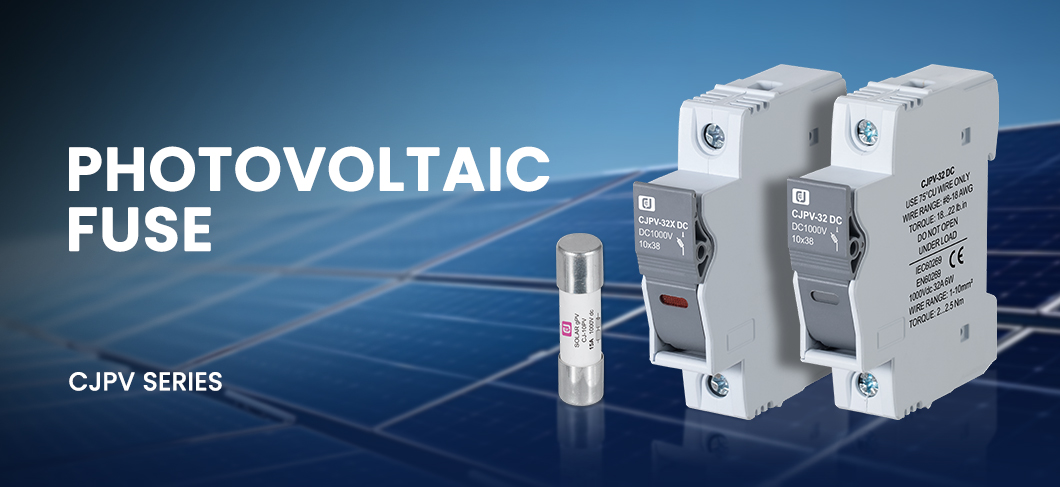
Introducing C&J Electrical CJPV-32 PV Fuse Holder
1. Overview of CJPV-32 PV Fuse Holder
2. Core Features of CJPV-32 PV Fuse Holder
- DIN35 Rail Installation, Easy to Install: Adopting standard DIN35 rail mounting design, the CJPV-32 PV Fuse Holder can be quickly installed on the standard rail in the electrical cabinet, saving installation time and labor costs. It is compatible with most electrical cabinet designs, facilitating system integration[4][3].
- Adjustable Terminal Block, Wiring Firm: Equipped with adjustable terminal blocks, it can adapt to different wire specifications, ensuring firm and reliable wiring. Loose connections are one of the main causes of overheating in Fuse Holders, and the adjustable terminal design effectively avoids this problem, ensuring stable current transmission[4][6].
- Fire-retardant Shell, High Temperature Resistance: Made of high-quality refractory and fire-retardant materials, the shell has excellent high-temperature resistance and flame-retardant performance. It can withstand high temperatures generated during Fuse tripping and prevent fire spread, further improving the safety of the entire system[6].
- Flexible Installation, Easy to Replace: The flexible installation design allows the CJPV-32 PV Fuse Holder to be installed in various narrow spaces, adapting to different installation scenarios. At the same time, the Fuse replacement process is simple and quick, reducing maintenance time and costs[4].
- Excellent Electrical Performance: With a breaking capacity of 20kA, it can quickly cut off short-circuit current, effectively protecting the circuit and equipment. The product has a compact design, low power loss, and excellent DC performance, which is perfectly suitable for the high-voltage DC environment of solar systems[3].
- Low Arc Voltage and Low Energy Let-Through (I2t): During fault tripping, the low arc voltage and low energy let-through can reduce the damage to surrounding components, ensuring the stability of the entire system and extending the service life of related equipment[6].
3. Technical Data of CJPV-32 PV Fuse Holder
|
Technical Parameters
|
Specifications
|
|---|---|
|
Standard
|
IEC 60269-6
|
|
Pole
|
1P, 2P, 3P, 4P
|
|
Rated Working Voltage
|
1000VDC
|
|
Rated Current
|
32A (1~32A adjustable)
|
|
Breaking Capacity
|
20kA
|
|
Storage Temperature
|
-40°C~120°C; At 40°C, relative humidity ≤70%; Below 30°C, ≤80%; Below 20°C, ≤90%
|
|
Packaging and Storage Temperature
|
-40°C~80°C; Relative humidity ≤90%, no condensation
|
4. Vibration, Shock Resistance and Altitude Adaptability
- Vibration and Shock Resistance: It has good resistance to vibration and impact, and can withstand more than 20g of impact, complying with the IT application environment of rail transit and the use requirements of general motor vehicles. For application environments with strong vibration, relevant tests can be negotiated according to user needs, ensuring long-term stable operation[6].
-
Altitude Adaptability: Suitable for use at altitudes of 2000-4500m. Higher altitudes mainly lead to insulation deterioration, poor heat dissipation, and air pressure changes. The product has corresponding adaptive characteristics[3]:
- The temperature rise of the Fuse increases by 0.1-0.5K for every 100m above sea level.
- For every 100m increase in altitude, the average ambient temperature decreases by about 0.5K.
- In open environments, the impact of altitude on rated current can be ignored.
- In closed environments, if the air temperature or cabinet temperature does not decrease with altitude and remains above 40°C, the rated current needs to be reduced by 2%-5% for every 1000m increase in altitude.
- Within 2000-4500m, the insulation strength decreases by 12-15% for every 1000m increase in altitude; users need to consider the insulation gap between the Fuse and other live structures and the ground.
5. Application Scenarios of CJPV-32 PV Fuse Holder
- Solar PV Systems: Installed between solar panels and MPPT charge controllers, as well as in combiner boxes and junction boxes, to protect solar panel strings, MPPT controllers, and connecting wires from short-circuit and overcurrent damage. It is suitable for residential, commercial, and utility-scale solar systems[1][2][5].
- High and Low Voltage Distribution Systems: Used in distribution cabinets, distribution boxes, and power distribution stations to protect power distribution lines and equipment from overcurrent and short-circuit faults[3][5].
- Control Systems: Applied in industrial control systems, such as PLC control cabinets and frequency converter control systems, to protect control circuits and components, ensuring the stable operation of the control system[3][5].
- Electrical Equipment: Suitable for various electrical equipment such as inverters, transformers, and motors, providing overcurrent protection for equipment circuits and extending the service life of equipment[3][5].
- Special Environments: Due to its excellent high-temperature resistance, vibration resistance, and altitude adaptability, it can also be used in harsh environments such as rail transit, outdoor power stations, and high-altitude areas[6].
6. Product Advantages of CJPV-32 PV Fuse Holder
- Compliance with International Standards: Meets the IEC 60269-6 standard[3][7], ensuring that the product’s performance and safety comply with international requirements, and can be widely used in domestic and foreign markets[3].
- High Safety Performance: Made of fire-retardant and refractory materials, with high temperature resistance and flame-retardant performance; equipped with reliable terminal blocks to avoid loose connections and overheating; high breaking capacity and low arc voltage, ensuring safe and reliable operation[6].
- Multiple Specifications Optional: Available in 1P, 2P, 3P, 4P pole types, and the rated current ranges from 1A to 32A, which can be flexibly matched according to different circuit requirements and application scenarios[3][5].
- Widely Applicable Scenarios: Suitable for solar systems, distribution systems, control systems, and various electrical equipment, with strong adaptability to different working environments (high temperature, low temperature, high altitude, strong vibration)[5][6].
- Easy to Install and Maintain: DIN35 rail installation design, simple and quick installation; flexible installation and easy Fuse replacement, reducing installation and maintenance costs[4].
- OEM/ODM Customization Support: C&J Electrical provides OEM/ODM brand customization services for the CJPV-32 PV Fuse Holder. We can customize the product according to the specific needs of users, including brand LOGO, product specifications, and functional settings, to meet the personalized needs of different users and partners[3].
Contact Us
Post time: May-18-2026