

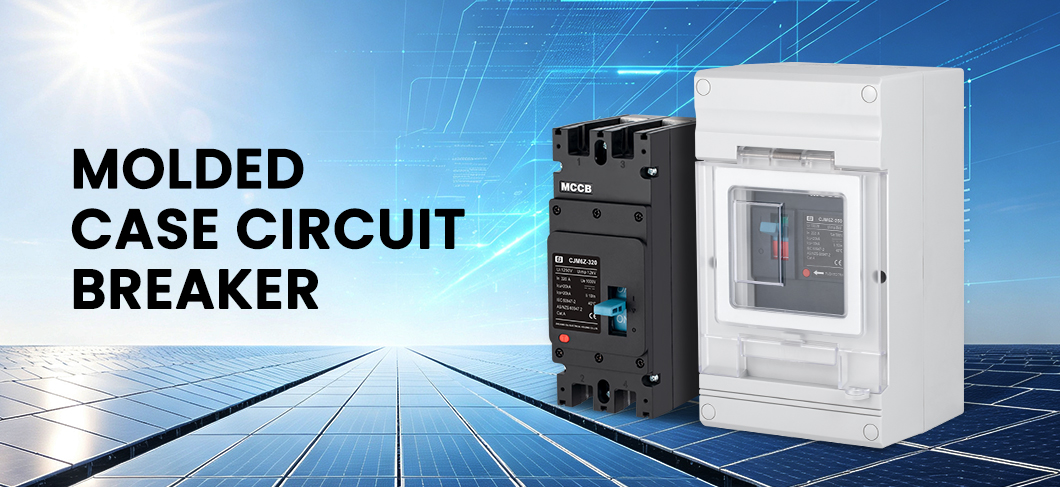
Why DC breaking is different, which ratings to check, and how the CJM6Z DC moulded case circuit breaker from C&J Electrical is applied to solar and storage systems
A DC circuit breaker used on the DC side of a solar array or a battery storage system is not an AC breaker with a different label. Direct current has no natural zero crossing, so the arc that forms when the contacts open does not extinguish itself the way it does on an AC circuit. A device that clears a fault on an AC feeder can therefore fail to clear the same fault on a DC string. Selecting a DC MCCB means working with voltage ratings that go well above the usual AC values, up to DC 1500 V, and checking that the breaking capacity matches the fault level at the point of installation. This article covers what to check when selecting a DC moulded case circuit breaker for solar duty, and how the CJM6Z DC series from C&J Electrical is applied to these systems.
Why breaking DC is harder than breaking AC
On an AC system the current passes through zero twice per cycle, and the arc is extinguished as the current falls. On a DC system the current continues to flow in one direction, so the arc must be driven out and cooled by the arc chute before the circuit is actually broken. The higher the DC voltage, the harder this becomes. This is why DC breakers are rated for specific DC voltages rather than being converted from AC ratings, and why the required arcing distance grows with the voltage class. It is also why protective devices on the DC side of a photovoltaic installation are selected as DC devices in their own right.
What to check when selecting a DC MCCB
- Rated voltage. DC systems are built at several levels, commonly DC 500 V, DC 1000 V and DC 1500 V. The rated operating voltage of the breaker must cover the highest voltage the circuit can see, including the open circuit voltage of a string.
- Rated current. The rated current is selected from the continuous current of the circuit, with the applicable installation rules taken into account.
- Breaking capacity. Icu and Ics must be checked against the prospective short-circuit current at the installation point. Because the fault current on a DC array depends on the source characteristics, this is verified for each project rather than assumed.
- Poles and wiring. DC MCCBs for these systems are commonly 2-pole and 3-pole, and the line and load terminals are defined by the manufacturer.
- Accessories. Remote tripping, position signalling and undervoltage protection are often part of a solar or storage protection scheme, so the availability of releases and contacts matters at selection stage.
Introducing the CJM6Z DC series
The CJM6Z DC is a moulded case circuit breaker developed by C&J Electrical for direct current applications. The series is built in frame sizes of 250 A, 320 A, 400 A and 630/800 A, in 2-pole and 3-pole versions, and is rated for DC 500 V, DC 1000 V and DC 1500 V depending on the frame. The breakers comply with IEC/EN 60947-2, carry utilization category A and provide an isolation function. Connection can be made with the top as the incoming line and outgoing from the bottom, or the reverse. Ambient temperature range is -35 °C to +70 °C, and the installation site elevation is up to 2500 m.
Key technical data of the CJM6Z DC series:
| Standard | IEC/EN 60947-2 |
| Frame | CJM6Z-250, CJM6Z-320, CJM6Z-400, CJM6Z-630/800 |
| Number of poles | 2P, 3P (CJM6Z-320: 2P and 3P; CJM6Z-250, 400, 630/800: 2P) |
| Rated voltage Ue | DC 500 V, DC 1000 V, DC 1500 V (depending on frame) |
| Rated insulation voltage Ui | DC 1000 V, DC 1250 V, DC 1500 V (depending on frame) |
| Rated impulse withstand voltage Uimp | 8 kV, 12 kV (depending on frame) |
| Rated current In | 250 frame: 100/125/140/160/180/200/225/250 A; 320 frame: 63/80/100/125/140/160/180/200/225/250/280/320 A; 400 frame: 225/250/315/350/400 A; 630/800 frame: 500/630/700/800 A |
| Ultimate short-circuit breaking capacity Icu | up to 70 kA (CJM6Z-250: 20 kA; the value depends on frame and DC voltage class) |
| Service short-circuit breaking capacity Ics | up to 70 kA (CJM6Z-250: 10 kA; the value depends on frame and DC voltage class) |
| Utilization category | A |
| Isolation function | Yes |
| Connection mode | Top incoming line and line out from bottom, or bottom incoming line and line out from top |
| Arcing distance | not more than 50 mm (250/320 frames); not more than 100 mm (400/630/800 frames) |
| Mechanical life | 15,000 operations (250/320 frames); 10,000 (400 frame); 5,000 (630/800 frame) |
| Electrical life | 3,000 / 2,000 / 1,500 operations (250/320 frames); 1,000 / 700 operations (400/630/800 frames) |
| Release type | Electro-magnetic release (200); thermo-magnetic + electro-magnetic release (300) |
| Accessories | Shunt trip, auxiliary contact, alarm contact, hand operator, motor operator |
| Ambient temperature | -35 °C to +70 °C |
| Installation site elevation | not more than 2500 m |
| Dimensions (L x W x H) | 165 x 78 x 113 mm (250, 2P); 200 x 80 x 135 mm (2P); 200 x 114 x 135 mm (3P); 270 x 125 x 169 mm |
Note: the values above are those declared for the CJM6Z DC series in the catalogue. Breaking capacity depends on the frame and the DC voltage class, and final selection must take account of the actual voltage and prospective short-circuit current of the installation.
Where the CJM6Z DC is used
According to the catalogue the series is intended for direct current circuits in the frame and voltage ranges listed above. Typical positions in a solar or storage installation include:
- DC side of photovoltaic arrays, where strings and combiners require a breaker rated for the system DC voltage.
- Battery and energy storage circuits, where the breaker is required to isolate a DC branch.
- DC distribution boards that need a 2-pole or 3-pole device with a defined DC voltage rating.
- Installations where the breaker has to provide an isolation function in addition to overcurrent protection.
Accessories for DC protection schemes
The CJM6Z DC accepts a range of internal and external accessories that are used in DC protection and control schemes:
- Shunt release. Rated for AC 230 V or 400 V, DC 220 V or 24 V, and required to trip the breaker reliably when the operating voltage is between 70% and 110% of the rated control voltage.
- Undervoltage release, used where the circuit must open when the control voltage is lost.
- Auxiliary contact and alarm contact, for position and fault signalling. Conventional thermal current is 3 A for frames below 250 A and 6 A above 400 A, with an alarm contact rating of Ue 220 V and Ith 3 A.
- Hand operator and motor operator, including a rotary handle mechanism for panel mounting.
Installation and use points
The catalogue lists a number of points that matter on site. Terminals and fixing screws must be checked for tightness before energising, and the wiring must be verified. Insulation resistance is measured between phases and between phase and ground with a megohmmeter. Where the breaker is fitted with an undervoltage release, the release must be connected to the rated voltage before the breaker is closed. Where auxiliary and alarm contacts are fitted, their signals are checked by operating the breaker and by pressing the emergency trip button. Breakers supplied with an electric or manual operating mechanism are operated three to five times to confirm reliable operation. The characteristics and accessories are set by the manufacturer and are not to be adjusted in service; under the stated storage and use conditions the breaker seal remains intact for 24 months from the date of shipment, and manufacturing quality issues are covered by replacement or repair.
About C&J Electrical
Zhejiang C&J Electrical Co., Ltd. is a manufacturer of low-voltage electrical products, focused on circuit breakers and related protection devices. C&J Electrical supports OEM brand customisation, offers a range of specifications, and can ship products as SKD kits for local assembly.
For more information on the CJM6Z DC series or to request a quotation, please contact us.
Post time: Sep-16-2026