

In modern electrical systems, whether residential, commercial, or industrial, transient overvoltages (surges) pose a persistent threat to electrical and electronic equipment. These surges can be caused by lightning strikes, power grid fluctuations, equipment switching operations, or even internal electrical system malfunctions. While many people are aware that aSurge Protection Device (SPD) is essential for safeguarding equipment, they often struggle with the question: How is a surge protector used? Understanding its working principle, correct installation method, and key usage points is crucial to maximizing its protection effect and extending the service life of connected devices. This article will comprehensively answer this question, elaborate on the core working mechanism of surge protectors, and focus on introducing the CJ-T2-C40 Surge Protective Device from Zhejiang C&J Electrical co., ltd. (C&J Electrical)—a high-performance Ac Surge Protection Device designed for low-voltage AC power supply systems, providing reliable surge protection for various scenarios.
Overview of C&J Electrical CJ-T2-C40 Surge Protective Device
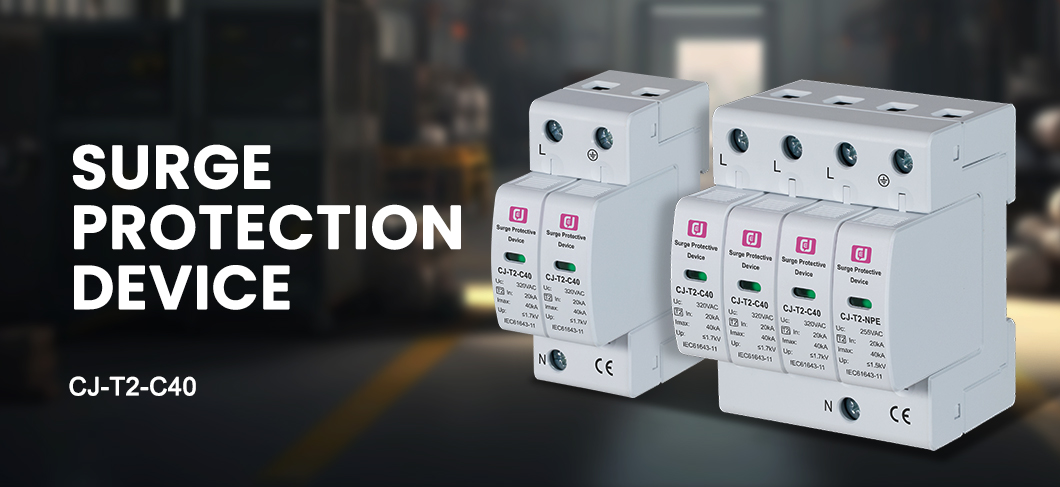
Core Functions & Product Advantages of CJ-T2-C40 SPD
- Fast and Reliable Surge Suppression: Equipped with high-performance metal oxide varistors (MOVs) as the core protection component, the device has a response time of less than 25ns, which can quickly detect and suppress transient surges. With a nominal discharge current of 15kA/20kA and a maximum discharge current of 30kA/40kA, it can effectively absorb and divert large-capacity surge energy, ensuring that the line voltage is clamped to a safe range and protecting downstream equipment from overvoltage damage.
- Intelligent Fault Indication & Isolation: The built-in fault release module can automatically isolate the faulty device from the power system when overheating or overcurrent occurs, preventing secondary risks. The visual status indicator (green for normal, red for abnormal) allows users and maintenance personnel to quickly identify the working status of the SPD without professional testing tools, reducing maintenance costs and time.
- Live Module Replacement: The modular design supports live replacement, which solves the problem that the entire system needs to be shut down during traditional SPD maintenance. This feature is particularly important for scenarios that require continuous power supply, such as data centers, hospitals, and industrial production lines, ensuring the continuity of the power system.
- Wide Compatibility & Versatility: Suitable for TN-S, TN-C-S, TT, IT and other low-voltage AC power supply systems, and applicable to Class C lightning protection scenarios. It can be installed in various environments and equipment, meeting the surge protection needs of different projects and scenarios.
- Durable and Stable Structure: The outer cover is made of fiber glass reinforced plastic, which has excellent flame-retardant, high-temperature resistant, and corrosion-resistant properties. It can work stably in harsh environments with an operating temperature range of -40°C to +85°C and a relative humidity of ≤95% (at 25°C), adapting to various complex working conditions such as high temperature, low temperature, and high humidity.
- Easy Installation & Standard Compliance: Adopts 35mm standard DIN rail mounting, which is consistent with mainstream electrical installation specifications, simplifying the installation process and reducing labor costs. The product strictly complies with IEC61643-1 and GB18802.1 standards[4], ensuring stable performance and meeting the safety requirements of global power systems.
- Complete Specifications & OEM Customization: The product has a variety of specifications to choose from, which can be customized according to the specific needs of different users and projects. We support OEM brand customization services, providing personalized solutions such as brand labeling and packaging design to meet the personalized needs of partners in different markets.
- High Safety Performance: The device is equipped with a 32A fuse/switch for secondary protection, and the L/N line and PE line have reasonable cross-sectional designs (10/16mm² for L/N line, 10/25mm² for PE line), ensuring the safety and stability of the circuit during operation and preventing risks such as line overheating and short circuits.
Technical Data of CJ-T2-C40 Surge Protective Device
|
Technical Parameter
|
Specification Details
|
|---|---|
|
Model
|
CJ-T2-C40
|
|
Nominal Discharge Current In(8/20μs)
|
20kA/15kA
|
|
Maximum Discharge Current Imax(8/20μs)
|
40kA/30kA
|
|
Response Time
|
<25 ns
|
|
Test Standard
|
GB18802/IEC61643-1
|
|
Cross Section of L/N Line
|
10/16 mm²
|
|
Cross Section of PE Line
|
10/25 mm²
|
|
Fuse or Switch
|
32A
|
|
Operating Environment
|
-40°C ~ +85°C
|
|
Relative Humidity (25°C)
|
≤95%
|
|
Installation Method
|
35mm Standard DIN Rail
|
|
Outer Covering Material
|
Fiber glass reinforced plastic
|
Application Scenarios of CJ-T2-C40 Surge Protective Device
- Residential Buildings: Installed in household distribution boards, the CJ-T2-C40 protects household electrical appliances such as refrigerators, air conditioners, televisions, computers, and washing machines from surges caused by lightning strikes, power grid fluctuations, or the switching of large electrical equipment. It effectively avoids equipment damage, short circuits, or even fires caused by surges, safeguarding the safety of household electricity use and property.
- Commercial & Office Spaces: Used in the power distribution systems of office buildings, shopping malls, hotels, restaurants, schools, and hospitals. It protects office equipment (computers, printers, servers), communication equipment, lighting systems, and air conditioning systems from surge damage. For places such as data centers and server rooms that require high stability of electrical equipment, the CJ-T2-C40 provides 24-hour reliable surge protection, ensuring the continuity of work and services.
- Industrial Sites: Installed in the socket boxes in front of control equipment or near control equipment in factories, workshops, and industrial parks. It protects electronic control equipment, production machinery, and information systems from surge damage, avoiding production interruptions caused by equipment failure and reducing economic losses. It is also suitable for petrochemical, environmental protection, and new energy industries that have high requirements for electrical safety[1].
- Information & Communication Facilities: Applied in computer rooms, data centers, communication base stations, and network operation centers. These places are equipped with a large number of sensitive electronic equipment (servers, switches, routers) that are highly sensitive to transient overvoltages. The CJ-T2-C40 can quickly suppress surges, ensuring the stable operation of information transmission and avoiding data loss or equipment damage.
- Public Facilities: Installed in the power distribution systems of community public areas, parks, roads, and traffic signal systems. It protects public electrical equipment such as street lights, traffic signals, and monitoring equipment from surge damage, ensuring the normal operation of public services and maintaining public order.
Why Choose C&J Electrical CJ-T2-C40 Surge Protective Device?
Post time: Apr-07-2026